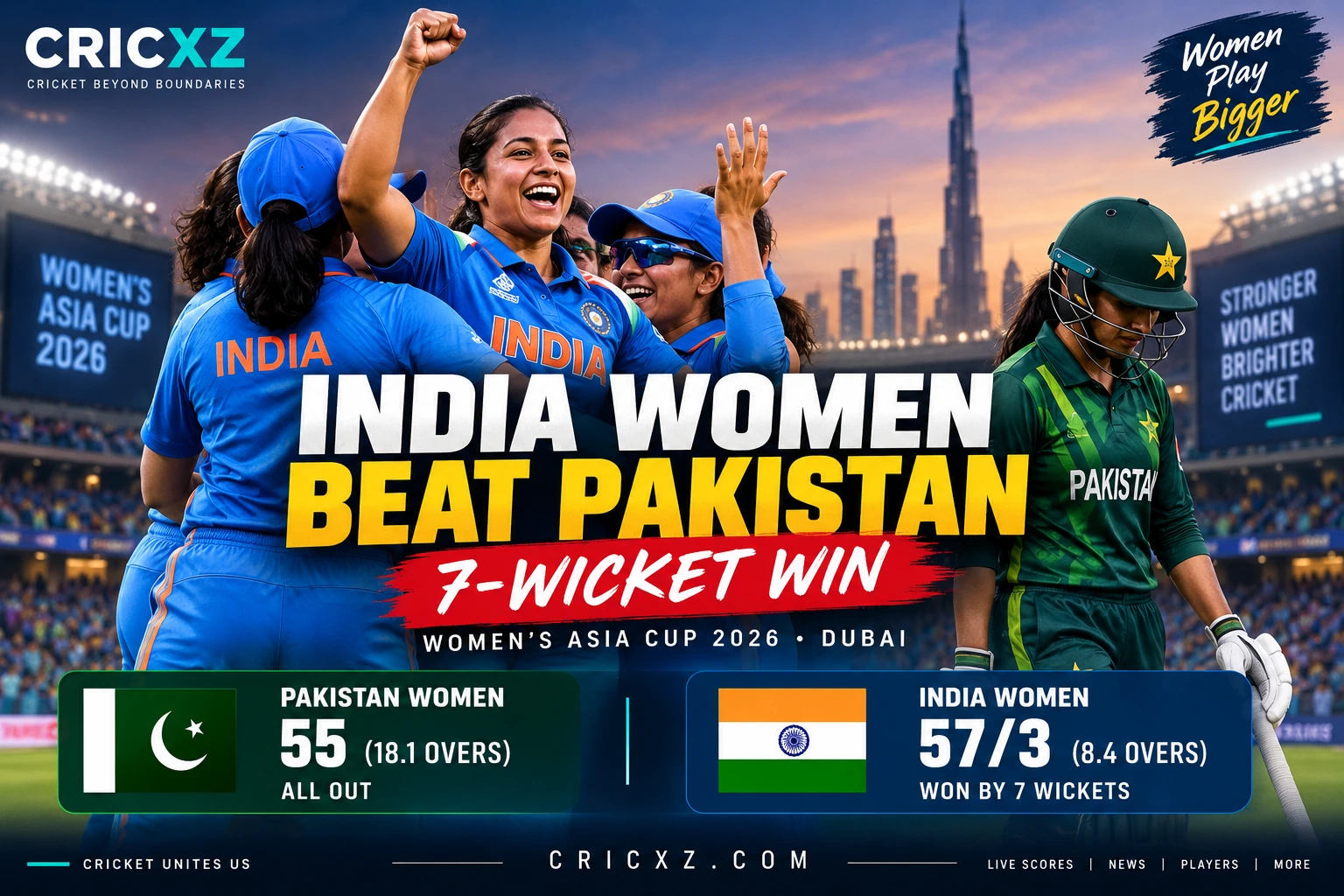
India Women produced one of the most dominant performances of the Women's Asia Cup 2026 as they defeated Pakistan Women by seven wickets at the Dubai International Cricket Stadium on 5 September. Pakistan were bowled out for just 55 in 18.1 overs before India raced to 57 for three in only 8.4 overs, completing the chase with 68 balls remaining.
The result gave India a third consecutive victory in Group A after earlier wins over Thailand and Hong Kong, China. It also completed an unbeaten group-stage campaign for Harmanpreet Kaur's side and underlined India's strength with both spin bowling and batting depth ahead of the knockout phase.
India Women vs Pakistan Women: match result
Pakistan won the toss and chose to bat first, but the innings quickly unravelled against India's spin attack. Wickets fell at regular intervals and Pakistan never managed to build a meaningful partnership.
Pakistan were eventually dismissed for 55 in 18.1 overs. India then chased the target in 8.4 overs, finishing on 57 for three to seal victory by seven wickets.
The margin of victory reflected India's control of the match. With a modest target required, the chase never demanded sustained risk and India were able to complete the contest with more than half of their allotted overs unused.
Pakistan collapse under pressure from India's spinners
The decisive phase of the match came during Pakistan's innings. India's spinners applied immediate pressure, restricting scoring opportunities while continuing to take wickets.
Shree Charani and Prema Rawat were the leading wicket-takers for India, claiming three wickets each. Charani finished with three for seven from four overs, while Rawat returned three for nine from her four-over spell.
Pakistan's top order struggled to recover from the early damage. Shawaal Zulfiqar finished as the team's highest scorer with 14 from 14 balls, while Muneeba Ali made 13 from 15. No Pakistan batter was able to produce the longer innings needed to rebuild the total.
Shree Charani and Prema Rawat lead the bowling attack
India's victory was built around a disciplined spin-bowling performance. Charani and Rawat combined for six wickets while conceding only 16 runs across their eight overs.
Their ability to attack the stumps, control the scoring rate and maintain pressure left Pakistan with little room to recover. The performance also demonstrated the depth available to India beyond its more established bowling names.
For India, that depth could be particularly important in the knockout stage, where conditions in Dubai may continue to reward bowlers capable of varying pace and using the surface effectively.
India lose three wickets but finish chase comfortably
Pakistan captain Fatima Sana gave her side a brief opening during India's chase by taking all three wickets to fall. She finished with three wickets for 17 runs from three overs.
Shafali Verma contributed a quick 12 from six balls, helping India move rapidly towards the small target. Despite Pakistan's wickets, the required total was never large enough to create sustained pressure.
Captain Harmanpreet Kaur remained unbeaten on 18 from 18 balls, while Deepti Sharma was unbeaten on 12 from 14. The pair took India past the target at 57 for three in the ninth over.
India complete perfect Group A campaign
The Pakistan victory continued India's unbeaten run in the Women's Asia Cup 2026. India had opened the tournament by defeating Thailand by 94 runs before producing an even bigger 137-run victory against Hong Kong, China.
Smriti Mandhana was the headline performer in the Hong Kong, China match, scoring 124 from 64 balls. That innings took her to 10,880 international runs and 18 international centuries, both major milestones in women's international cricket.
India's win over Pakistan made it three victories from three Group A matches. With the top two teams from each group advancing to the semi-finals, India ended their group programme in a commanding position and with significant momentum heading into the knockout stage.
Pakistan's batting problems prove costly
Pakistan entered the match after defeating Thailand by 35 runs in their opening fixture, but their batting was unable to withstand India's sustained pressure.
Muneeba Ali had scored 54 against Thailand and was again one of the few Pakistan batters to reach double figures against India. However, regular wickets prevented Pakistan from establishing the partnerships required to post a competitive total.
The performance means Pakistan must quickly regroup for the remainder of their Group A campaign as the race for the second semi-final place continues.
India's bowling depth sends strong knockout message
While India's batting had attracted much of the attention earlier in the competition, particularly after Mandhana's record-breaking century, the Pakistan match highlighted the team's bowling resources.
Restricting an international opponent to 55 demonstrated India's ability to control a game even when its leading batters are not required to produce a major score. Charani and Rawat's combined six wickets were central to that performance.
The balance between attacking batting and multiple bowling options gives India several ways to influence matches as the tournament moves towards its decisive stage.
Three very different wins for India
India's three Group A victories have arrived in different circumstances. Against Thailand, Shafali Verma's attacking innings helped establish a strong total before the bowlers completed a 94-run win.
Against Hong Kong, China, Mandhana's 124 powered India to 193 for five and a 137-run victory. Against Pakistan, it was the bowlers who dictated the contest by dismissing the opposition for 55 before the target was chased inside nine overs.
That variety is an encouraging sign for India because tournament cricket often requires teams to adapt quickly to different match situations rather than depend on a single player or method of winning.
What happens next for India
India can now turn its attention to the semi-finals after completing its Group A schedule without defeat. The knockout stage will bring greater pressure, but the team enters it after three convincing performances in Dubai.
The challenge will be to carry that form into the semi-final while continuing to make effective use of both its aggressive top order and its increasingly influential spin attack.
For Pakistan, the focus shifts to securing the results required to remain in contention for the other Group A semi-final position.
Information checked through 5 September 2026 after the match.