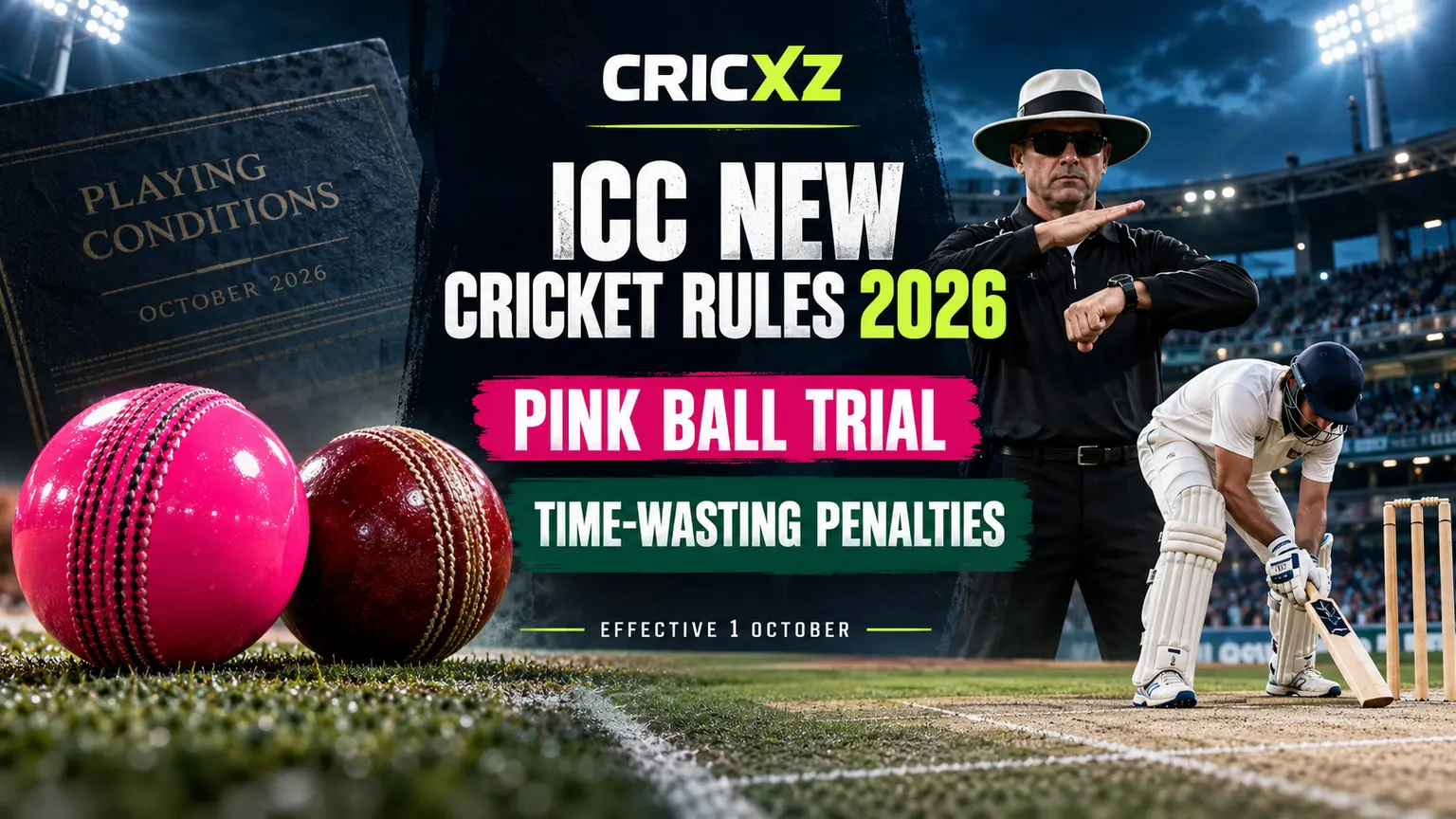
The International Cricket Council's updated Playing Conditions apply to international series beginning on or after 1 October 2026. Ongoing series that started earlier continue under the previous regulations. The changes cover all formats and include new rules for time-wasting, fielding, cricket balls and match intervals.
ICC Rules 2026: Quick Summary
Effective: Series starting on or after 1 October 2026
Major Test trial: Pink ball permitted in daytime Tests by prior mutual agreement
Time-wasting: Five-run penalty from a batter's third offence
T20I interval: Fixed at 15 minutes, reducible to 10 when time is lost
Pink Balls Can Be Used in Daytime Tests
The ICC has introduced a trial allowing a pink ball to be used in a daytime Test when both teams agree before the match. The purpose is to reduce playing time lost to bad light.
The decision must be made before the Test begins and applies for the entire match. Teams cannot switch from a red ball to a pink ball after play has started. This is therefore not an in-match replacement rule; it is a pre-match choice for the full Test.
Five-Run Penalty for Repeated Batter Time-Wasting
In men's international cricket, a batter who is not ready to face within the prescribed time receives a warning for the first offence and a final warning for the second. The third and every subsequent offence brings five penalty runs to the fielding side.
Repeated breaches may also be handled under the ICC Code of Conduct. The graduated system gives batters two warnings but introduces a direct scoreboard consequence if delays continue.
A Wicket Will Not Automatically End the Day
In Tests, a wicket in the final over of the day will no longer automatically end play when deliveries remain. If weather, light and playing conditions remain suitable, the over must continue.
The ICC explained that stopping at the wicket did not save time because the remaining balls still had to be delivered the next morning. Completing the over also preserves pressure created by the fielding team.
What Counts as an Overthrow?
The updated wording distinguishes an overthrow from a misfield. An overthrow is an attempt to direct the ball towards the stumps to prevent runs or complete a run-out. An unsuccessful attempt to stop the ball or pass it to another fielder is treated as a misfield, not an overthrow.
Umpires Get More Leeway on a Ball Being Finally Settled
A ball no longer needs to be in the hands of the bowler or wicketkeeper before an umpire can regard it as finally settled. The clarification is especially important at the end of close matches, when the precise moment the ball becomes dead can affect whether further runs are possible.
Complete Control Required for Run-Outs and Stumpings
A fielder must have complete control of the ball when breaking the wicket for a run-out or stumping. Simply touching the ball with a hand while that hand breaks the stumps does not establish that the fielder was holding it.
Women's Cricket Balls Get Tighter Specifications
The ICC has introduced separate, tighter size and weight tolerances for women's cricket balls. Previously, manufacturers often supplied one specification for both women's and junior cricket. The revised framework establishes distinct specifications for men's, women's and junior cricket.
T20I Interval Fixed at 15 Minutes
The scheduled innings interval in T20 internationals is now 15 minutes. When playing time has been lost, officials can reduce it to a minimum of 10 minutes.
Coaches Can Enter the Field at Drinks
ODI and T20I playing conditions are now aligned so that a head coach, or a person designated by the coach, may enter the field during scheduled drinks intervals. This formalises an opportunity for direct tactical communication without allowing unscheduled interruptions.
Leg-Side Wide Trial Becomes Permanent
The leg-side wide trial has been incorporated permanently into the ODI and T20I Playing Conditions. Match officials will apply the updated wording in international limited-overs series covered by the new regulations.
Why These Changes Matter
The package combines three aims: keeping matches moving, removing uncertainty from unusual fielding situations and preserving playing time. The daytime pink-ball provision may be particularly significant at venues where poor light regularly shortens Test sessions, while the five-run sanction gives umpires a clear response to repeated batting delays.
The changes were developed through the ICC's cricket committees. Sourav Ganguly, chair of the ICC Men's Cricket Committee, said the measures were intended to improve clarity and pace while maintaining the game's integrity.
Sources
- ICC — New Playing Conditions bring key changes across formats
- ICC — Key changes across formats explained
- ICC — Official Playing Conditions and regulations
This explainer summarises the ICC announcement published on 1 October 2026. Competition-specific playing conditions and official match rulings remain authoritative.